Understanding The Tanzanian Education System
When we talk about the Tanzanian education system, we often get questions about what each grade entails and how schooling is different in Tanzania from America.
So, to better understand the journey students take, let’s step into the Tanzanian education system together.
If a student completes every level of school, their educational journey looks something like this:
2 years of pre-primary school
⬇️
7 years of primary school
⬇️
4 years of secondary school
⬇️
2 years of advanced secondary school
⬇️
3+ years of tertiary education
Of course, not every student follows this exact path. There are different options for continuing education along the way. But first, let’s take a closer look at what each level of schooling looks like.
Pre-Primary School
Similar to preschool and kindergarten
Only one year of pre-primary school is required by the government, although access can be difficult for many families.
Public pre-primary schooling often primarily serves 5- and 6-year-olds and is designed to provide a foundation before students enter primary school.
Teachers focus on early childhood development, including letters, numbers, play, social-emotional learning, and creativity.
Primary School
Similar to grades 1-7 in America
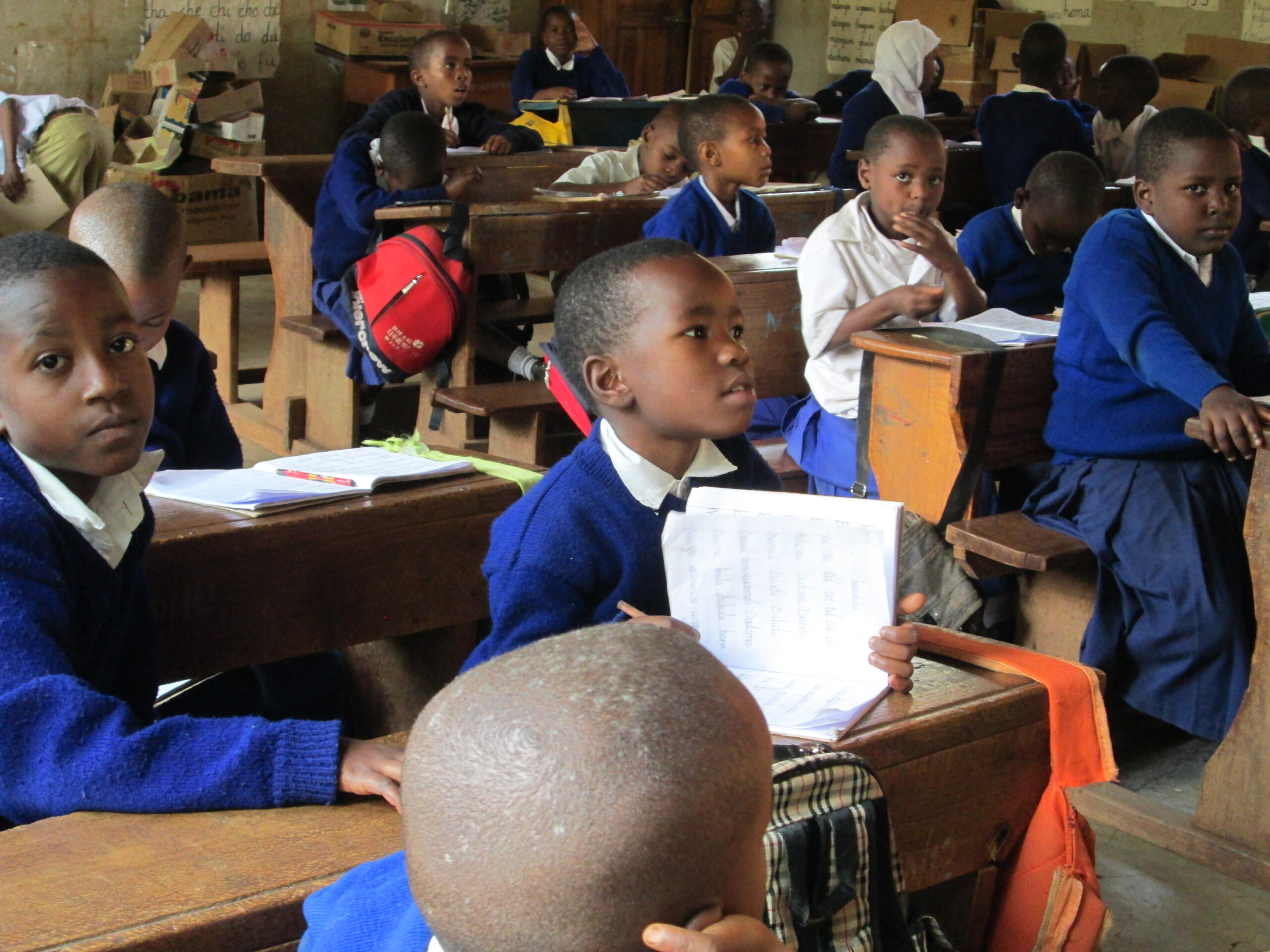
Most kids begin primary school around age 7. Primary education is taught mostly in the national language, Swahili, and students begin learning English as well.
In primary school, students learn a variety of subjects, including:
- math
- English
- Swahili
- science
- social studies
- life skills
- health education
- civics and moral education
- vocational skills
- physical education
- art
Primary school is divided into Standard 1 through Standard 7.
Students must take exams at the end of Standard 4 and Standard 7 to continue their education. At the end of Standard 7, students take the Primary School Leaving Exam. The results help determine whether and where a student will be able to attend secondary school.
Secondary School
Secondary school is taught primarily in English and is divided into two levels. The first is Ordinary Level, also known as junior secondary.
Ordinary Level, Form 1-4
Similar to grades 8-Junior Year of High School
In these grades, students have the chance to choose some of their subjects as they begin to narrow their studies to fit with a future career choice.
Students take core subjects such as:
- Math
- English
- Swahili
- Biology
- History
- Geography
- Civics
They can also take elective classes, including physics, chemistry, agriculture, information and computer science, commerce, bookkeeping and commerce, fine arts, music, and home economics.
At the end of Form 4, students take the Certificate of Secondary Education Exam. The results of this exam play an important role in determining what comes next. They influence whether students can continue to advanced-level secondary education or pursue vocational education.
Advanced Level: Form 5-6
Similar to Senior year and junior college
Students who pass the CSEE, move on to the Advanced level classes, or Form 5 and 6.
At this stage, students choose combinations of subjects based on their interests, and future aspirations, allowing them to focus their studies more closely on the path they hope to pursue
Here students choose combinations of subjects based on their future aspirations.
But completing A-Levels is not the only way to continue toward university.
If a student does not earn passing grades or receive top marks on the Form 4 National Exam, they may instead pursue a two-year college program to receive a diploma, similar to community college, or complete a certificate-level course.
After completing these programs, students still have the opportunity to apply to university to pursue a BA or BS.
The Challenges Students Face
Schooling in Tanzania has made strides in recent years, but the system still isn’t prepared to support the growing number of students it’s seeing, especially those whose families lack the means to afford schooling.
While the government has issued laws requiring education to be free, there are many costs that are not covered. As a result, families often find themselves responsible for costs such as:
- Uniforms and shoes
- School supplies
- Meals
- Classroom supplies
- Transportation and the distance students must travel to school
Beyond these challenges, many public schools also struggle with limited resources, high student-to-teacher ratios, and teacher shortages.
For families already facing financial challenges, these barriers can make it difficult for students to access school consistently and get the support they need to succeed.
How Toa Tumaini Foundation Steps In
This is where Toa Tumaini Foundation steps in.
Our goal is to improve access to education for families who are struggling to meet these challenges. We support students not only by helping them get into school, but by walking alongside them throughout their educational journey.
In partnership with donors, volunteers, and local community members, Toa Tumaini Foundation supports students and families by:
- Providing free preschool and starting students as early as 3-years-old
- Paying school fees and providing supplies for all students
- Covering tutor costs to improve student knowledge
- Meeting with students after exams to go over results and review correct answers
- Providing staff that serves as social-emotional support
- Conducting home visits to understand other barriers students and families face and build rapport with guardians
- Walking alongside students as they choose a career path
We believe education is about more than simply getting a student through the next grade. It is about creating opportunities, providing support when challenges arise, and helping students see a path toward their future.
By understanding how the Tanzanian education system works and the barriers many students face, we can better understand why access, resources, and consistent support matter so much.
And, most importantly, we can better illustrate why Toa Tumaini Foundation is committed to walking alongside Tanzanian students every step of the way.